
DeWitt City Directory Collection Runs
OCPL's holdings list supplies a narrow, named starting point for DeWitt research. The local row is a fiche run, not a claim of uninterrupted publication or coverage. It has no listed DeWitt film or print run. The regional material below is deliberately separate: it can help fill a date gap, but it must be checked for the place label and editorial area used in that volume.
| Collection | Years | Where Held | Access |
|---|---|---|---|
| DeWitt fiche, call number LN48 D517 D | 1953, 1955, 1957, 1959, 1961, 1963, 1967, 1969, 1972, 1974, 1985 | OCPL Local History/Genealogy, Central Library | Request or inspect through the desk |
| Onondaga County rural directory | 1917-1922 | OCPL | Regional fallback; confirm DeWitt coverage |
| Onondaga County directory | 1887 | OCPL | Regional fallback; not a DeWitt-specific run |
| Onondaga County business directory | 1891-1892 | OCPL | Regional fallback; business focus limits household use |
| Central New York Directory | 1896 | OCPL | Regional fallback; verify the geographic scope |
| Onondaga, Cayuga, Madison, and Cortland counties directory | 1881 | OCPL | Regional fallback; verify the entry's place line |
The listed DeWitt sequence skips 1965, 1966, 1968, 1970-1971, 1973, and 1975-1984. Those omissions describe the OCPL holdings row, not a conclusion that no directory existed in those years. Preserve the fiche year and call number in every research note.
Note: Syracuse volumes are a separate collection and require a check that the historical address was covered under that edition's place label.
DeWitt City Directory Fiche at OCPL
The OCPL Local History/Genealogy desk is on the third floor of Central Library, 447 South Salina Street in Syracuse. It serves research across Syracuse and Onondaga County as well as wider regional collections. Staff assist with family and local-history work, and the library asks researchers to use its query guidance before sending a detailed request. A bounded request works best: provide a surname variant, a street or address, the exact listed year, and the DeWitt fiche call number rather than asking for a broad list of people.
OCPL describes its Local History/Genealogy desk and its staff-assisted research resources on the source page for this image.
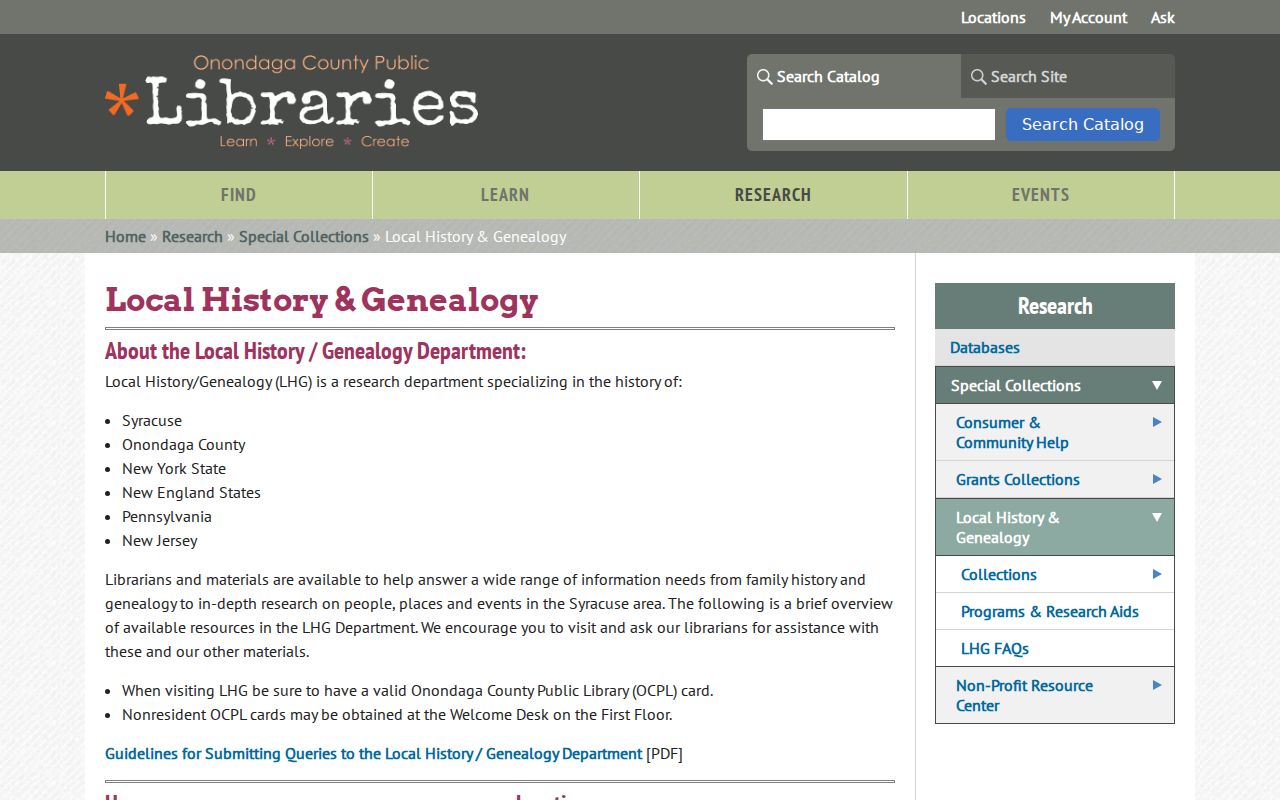
The desk also connects a listing to county censuses, newspapers, obituary indexes, cemetery cards, vital indexes, local maps, and closed-stack family material. Those companion sources help test whether a name, place, and date belong to the same historical household.
Hours published by OCPL list Monday, Thursday, Friday, and Saturday from 9:00 to 4:45, Tuesday and Wednesday from 9:00 to 7:15, and Sunday closed. A valid OCPL card is used for access, while nonresident cards may be available at the Welcome Desk. Confirm hours and access rules before making a special trip.
| 1953 | First listed DeWitt fiche year in the OCPL holdings row. |
|---|---|
| 1955-1974 | Listed DeWitt years continue intermittently through the 1974 fiche. |
| 1985 | Latest listed DeWitt fiche year in that row. |
| Today | Staff-assisted holdings, catalog searching, and the query route remain the practical access path. |
DeWitt Directory Names Beyond Fiche
OCPL's broader Syracuse holdings can supply another trail, but they should not be merged into the DeWitt row. Syracuse city and suburban directories are listed in microfiche for 1844-1862, on microfilm for 1862-1935, and in print from 1936 forward. Syracuse telephone directories are listed from 1894 forward. Before treating an entry as a DeWitt result, compare its address and place label with the historical geography of the address.
That distinction matters because DeWitt's present geography intersects postal and place names such as East Syracuse, Jamesville, Fayetteville, and Syracuse. A missing surname may call for another label or spelling, not an assumption that the household was absent. County censuses from 1855 through 1925, federal censuses, and the newspaper and obituary resources at OCPL are useful ways to test a possible regional hit.
Reading a DeWitt City Directory Entry
No scanned DeWitt fiche entry was captured in the research material. That inspection gap matters. Do not assume that every volume prints the same fields or uses the same abbreviations. When a fiche is viewed, log only the fields that appear on that page and photograph or note the volume's abbreviation key before interpreting a mark.
| Printed name and spelling | Record it exactly, including initials or a variant spelling, if present. |
|---|---|
| Occupation or descriptor | Log it only if printed; it may be absent or too brief to provide further detail. |
| Household or second-person line | Note a spouse, relative, or other line only when the entry actually supplies it. |
| Street and address | Keep the house number, street form, and the city or town label together. |
| Telephone or same-address notation | Preserve it as a source detail, not a statement of ownership or present occupancy. |
| Publication reference | Save the publisher, year, page, roll, or fiche identifier so the listing can be checked again. |
- Criss-cross directory
- A directory section arranged by street and number rather than by surname. Whether a listed DeWitt volume has one must be checked on the fiche.
- Householder index
- A name arrangement that may identify the person under whom a household was listed. It does not establish everyone who lived there.
- Abbreviation key
- The publisher's explanation of its shortened marks and terms, often near the front of a volume. Read it before expanding an abbreviation.
Note: A directory's subscriber, household head, owner, and resident labels can describe different people, so cross-check each claim with its source date.
DeWitt Research Through SydneyPlus
OCPL's SydneyPlus archive offers Search, Browse Collections, and My List functions, with collection-specific material rather than one uniform index. Its holdings include 1855 and 1865 census transcriptions for Syracuse and Onondaga, local news, necrology, obituary scrapbook material, Onondaga Families, vital records material, cemetery collections, a timeline, and WPA transcriptions of early newspapers.
Try a surname variant, DeWitt and Dewitt, East Syracuse, a street name, a cemetery, or a year. The visible portal controls did not expose exact field labels, required fields, result pagination, export options, or an index date during research. A null search is therefore not proof that no record exists. It may reflect the collection chosen, an alternate place label, or incomplete coverage.
The Onondaga Families collection can add surname files, donated genealogies, manuscripts, correspondence, and queries. Keep those materials distinct from an official deed or assessment record. They provide historical leads and relationship context, not a current address result.
St. Joseph's Cemetery and DeWitt History
SydneyPlus lists a St. Joseph's Cemetery collection with more than 6,000 burials from before a 1966 transfer. That is a useful historical hook when a name disappears between dated listings. A cemetery card or burial record may support a death-date or family-history question, but a burial place is not evidence of a home address or a complete household.
OCPL also describes cemetery cards organized by county, town, cemetery, and name. Pair a cemetery name with a surname or date, then compare the result with an obituary, county census, or vital index. The New York State vital index at the desk covers deaths and marriages from 1881 to 1964 and births through 1937, excluding New York City and Buffalo. It is an index, not the certificate itself.
DeWitt Archive Context at OHA
For photographs, clippings, pamphlets, programs, and local institutional history, the Onondaga Historical Association visit and research information is the source for this image. OHA was established in 1863 and maintains a subject finding aid that can be searched for DeWitt, East Syracuse, Jamesville, a street, an institution, an association, or a family name.
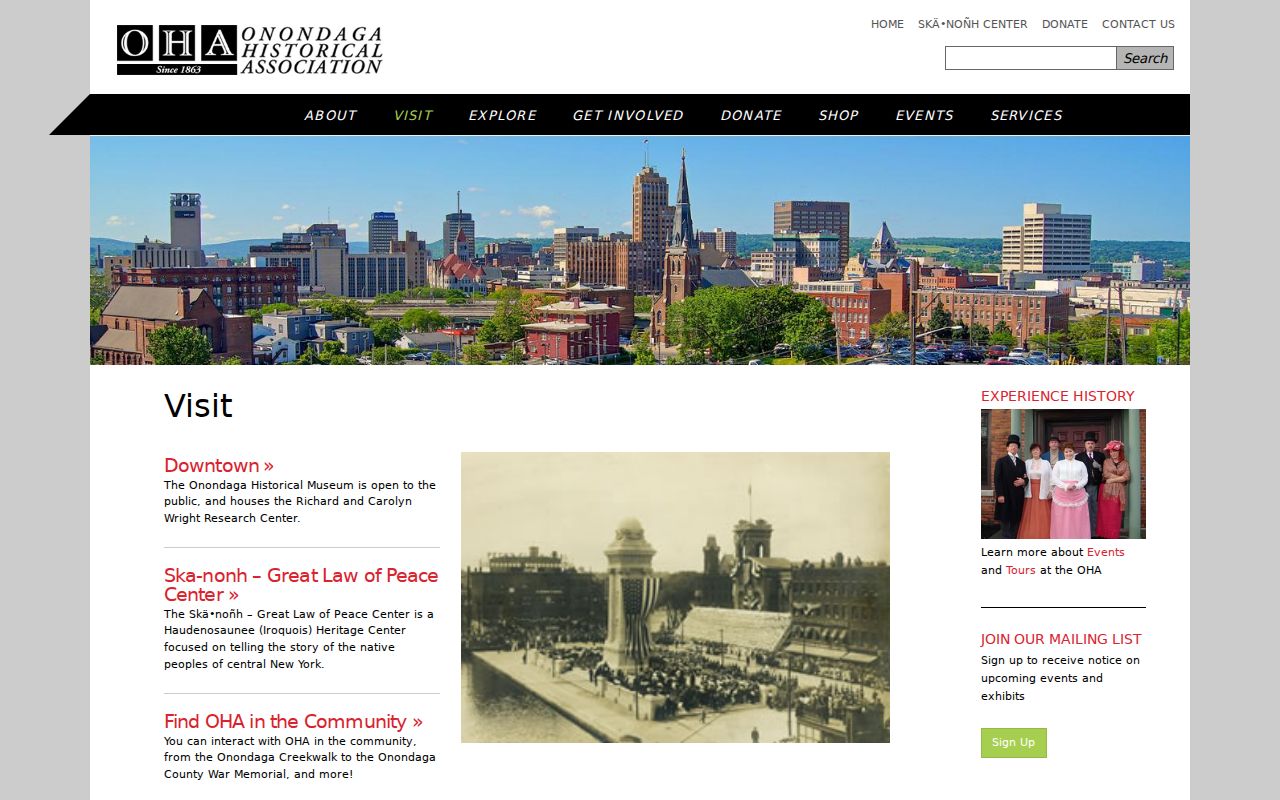
OHA is a contextual repository, not the custodian for county deeds or assessment rolls. Its 42-page subject finding aid can direct a researcher to local files that explain an address, institution, or community after a dated listing has been identified.
The Research Center was reported temporarily closed for construction, with reopening expected in fall 2026. Verify access before visiting or sending a researcher. OHA welcomes inquiries and lists research and scan or print fees, though the exact current schedule and request-form fields were not captured.
Trace DeWitt City Directories Across Years
A careful household trail is date by date. It should never claim continuous residence just because the same surname appears more than once. Start with a known name or address, preserve the source label used in each volume, and test the resulting history against county and library records. For a current parcel or street question, the address-based work belongs in the DeWitt street directory.
- Choose the nearest listed DeWitt fiche year and search the surname, its variants, and the historic place label.
- Log the printed spelling, street, place line, and fiche or page reference exactly as shown.
- Check the next available listed year, then use an appropriate Syracuse or regional fallback only after confirming its coverage.
- Pair each dated listing with the closest county or federal census geography, newspaper or obituary material, and cemetery or vital-index clue.
- Use the Onondaga County Clerk deed index and the Town Assessor's field-book route when a transfer date or parcel history needs independent confirmation.
If a household vanishes, write down the possibilities rather than choosing one: a move, death, changed spelling, changed postal label, unlisted telephone service, or a holdings gap. The Onondaga County Clerk Archives preserves county records from 1794 forward, while DeWitt assessor field books provide a locally described bridge from the early 1960s to today. Ask the custodian about access and keep a no-result as part of the record.
Note: A dated directory listing is a historical snapshot and should be paired with a second source before it supports a family-history conclusion.