
DeWitt Resident Lookup Records
No government office maintains one open roll of all DeWitt residents. Instead, a person-specific search moves between records with different purposes. The county assessment route can identify the owner recorded for a parcel, not its current occupant. A deed index can identify transfer parties. The voter tool lets a registered voter confirm that person’s own registration, rather than browsing names on a street. A court response, vital record, or historical directory also carries its own time period and role. That difference is the reason an exact name and ZIP code alone is not a sound identification.
| Record | What It Confirms | Where | Access |
|---|---|---|---|
| Assessment and parcel record | Current assessment owner, parcel, situs, and recorded mailing field | Onondaga RPTS and the DeWitt Assessor | Online routes plus the local office; verify roll currentness |
| Land-record index | Grantor, grantee, recording reference, and transfer trail | Cott Onondaga Land Records | Guest index is free; images need an account or a Clerk/archive fallback |
| Voter registration | A registered voter’s own registration and polling information | New York voter lookup | Personal self-lookup, not an open resident roll |
| Town Court matter | A clerk response about a local court question, subject to court rules | DeWitt Town Court | Written inquiry, mail, email, phone, or counter route; no public name docket located |
| Vital or historical record | A legal event, relationship, or dated household clue | Onondaga Vital Statistics and OCPL collections | Eligibility rules, genealogy limits, or staff-assisted access apply |
Start with RPTS or the Assessor when the question concerns a parcel. Start with OCPL’s dated collections when the question concerns an older household. Use a court or vital route only when it fits the event being checked. For a full address-keyed trail across a named street, the DeWitt street directory keeps that distinct workflow together.
Anchor a DeWitt Resident Match
A strong match needs two independent anchors. Useful pairs include a name and exact parcel number, a name and birth date, a name and exact historical address, or a name and court or custody identifier. The record’s role also matters. Owner, mailing addressee, directory subscriber, voter registrant, court party, incarcerated person, decedent, and heir are not interchangeable labels. A current owner field cannot establish who occupies a home. Likewise, a historical directory entry cannot establish a present address.
The DeWitt Assessor maintains ownership and inventory information for more than 11,000 parcels and field books from the early 1960s to today. That local bridge can help distinguish two same-named owners when the published RPTS route is thin. The Assessor retains deeds on transfers and receives permit copies, but the research did not find an online field-book search or published copying procedure. Ask the office about a specific parcel and retain the parcel number in the request.
The New York voter lookup form shows why an identity anchor matters: it requires last name, first name, date of birth, county, address information, and ZIP code from the registered voter. It is a confirmation tool for that voter, not a list of DeWitt people or a way to search a block.
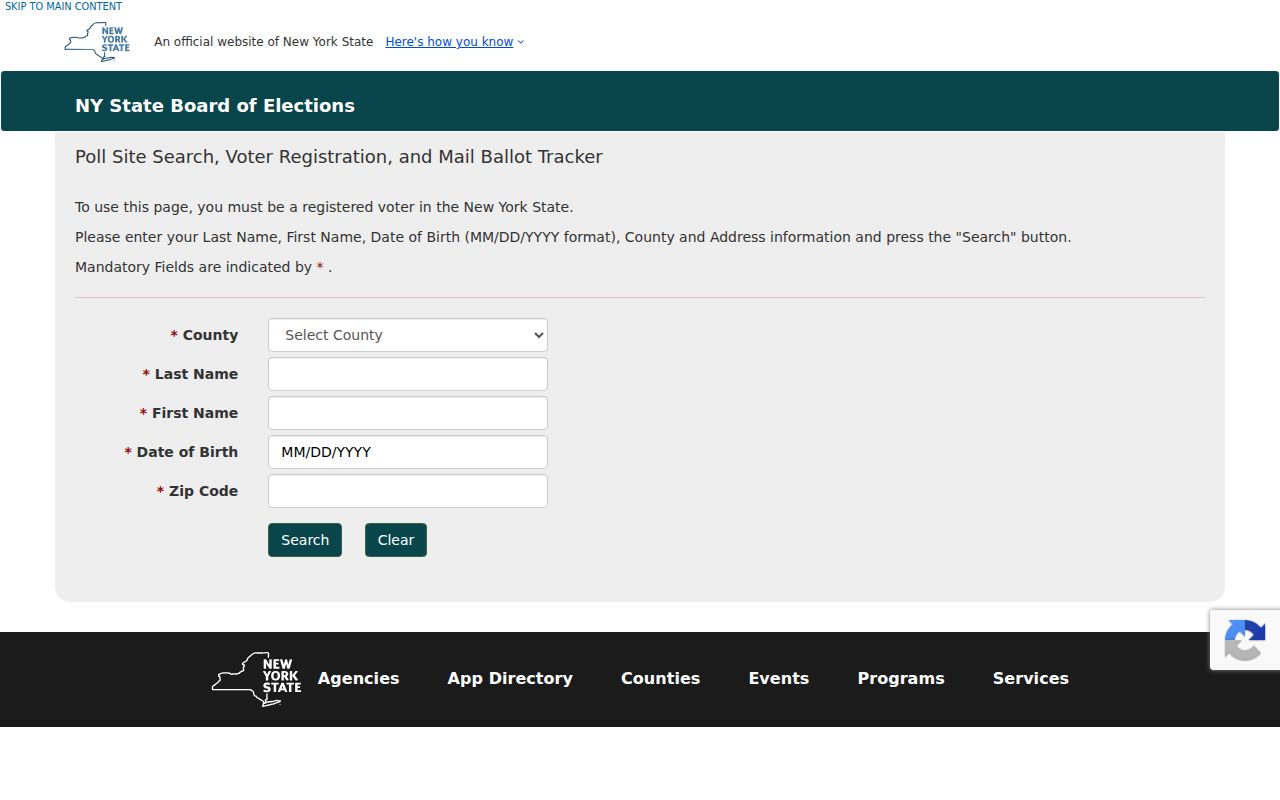
The required fields make the proper scope clear. A name and ZIP are only narrowing details, and confidential registrations may intentionally have no ordinary public result.
Note: Save the spelling searched, source date, record identifier, and the exact role stated by the source before comparing any second record.
DeWitt Court Name Checks
DeWitt Town Court has no public name-search docket in the documented route. For a local court question, send a written inquiry to the Court by email at court@dewittny.gov or mail it to 5400 Butternut Drive, East Syracuse, NY 13057. The Court asks for the name, birthdate, return address, and phone number. Court staff respond to the inquiry but cannot give legal advice. That is a more accurate path than treating a broad web search as a DeWitt case search.
Clerk hours are Monday through Friday, 8:30 a.m. to 4:30 p.m. Telephone routing is by last-name range: 315-446-9180 for A through K and 315-446-7136 for L through Z. Identify whether the request concerns a Town Court misdemeanor or traffic case before asking for status or a copy. A felony, Supreme Court civil case, estate, or divorce judgment can belong to a different custodian. Onondaga County Clerk and the New York Unified Court System provide the wider court routing, but the correct case type still controls.
A court response should be logged as a court record, never rewritten as a personal profile. If a result is available, retain the case or docket number, court, filing date, named parties, status, next date, disposition, and the label used by the custodian. No live DeWitt docket example or public field list was captured, so those items are a request checklist rather than promised online result fields.
The Onondaga County Justice Center lookup is a different, short-term custody system. Its published oversight description identifies fields such as name, Inmate Control Number, age, floor or pod, charges, court, next court date, agency, bond, and remarks.
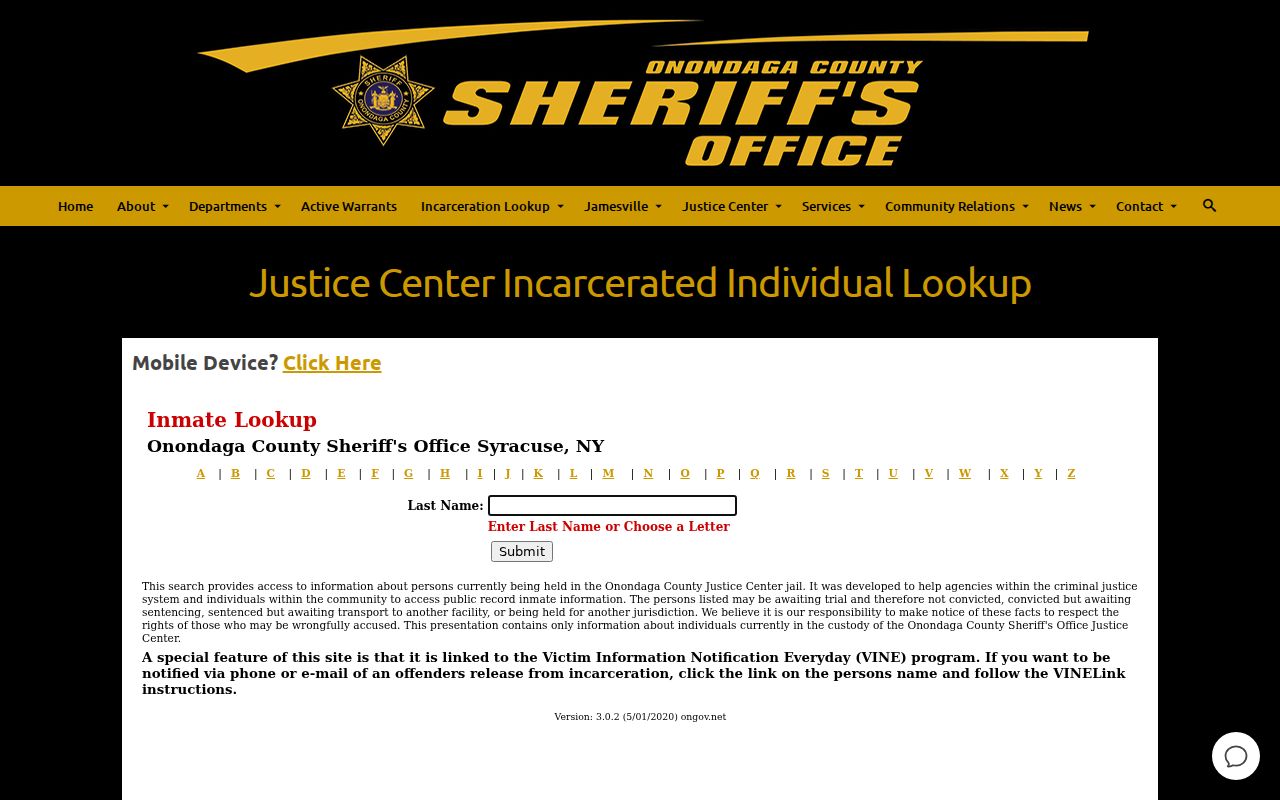
Custody, a charge, a court filing, a disposition, and a conviction are separate statuses. A roster result also does not establish a current DeWitt residence.
DeWitt Custody Record Labels
Use the record system that fits the status being checked. The Justice Center lookup concerns county custody. The state DOCCS lookup concerns state custody and uses a live-database preparation date. The New York DCJS Sex Offender Registry is a separate statutory directory. Its online search is limited to Level 2 and Level 3 information and accepts one of last name, county, or ZIP code, with a CAPTCHA and exclusion options. Level 1 or not-yet-set risk information follows a telephone route with an identifier requirement.
Use the result’s own date and label. An absence can reflect a jurisdiction, level, timing, confidentiality, spelling, or system difference, not a definitive finding. For a safety concern, verify through the responsible agency instead of relying on a copied result.
The DCJS registry search shows the legally limited options available to the public.
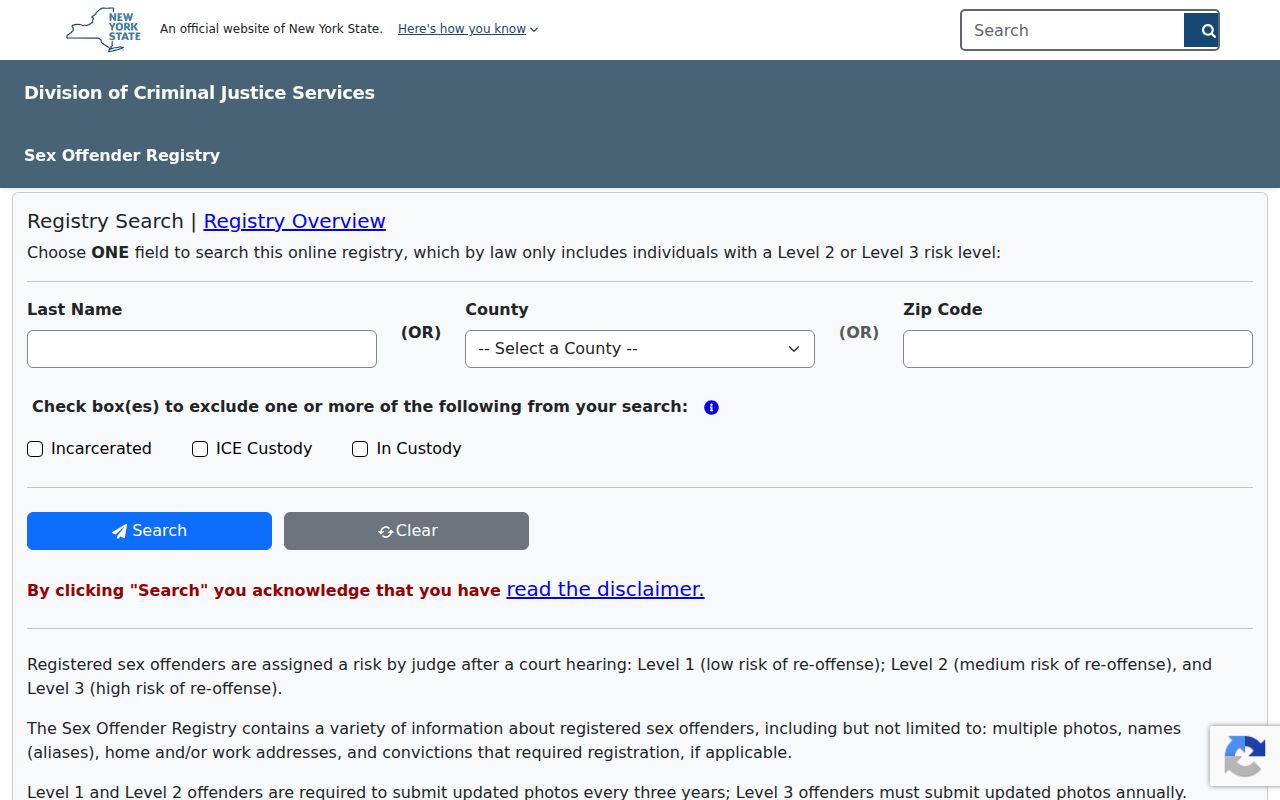
The single-field design is not a substitute for identifying a person through two independent official anchors.
Onondaga Events for DeWitt Residents
Vital records document events and relationships, not a live residence. The Onondaga Office of Vital Statistics holds county birth and death records for the past 150 years according to its office page. Certified birth and death requests may be made online, by mail, fax, or in person, with the form and identification required. The documented office fee is $30 for the first certificate and $15 for each additional certificate in the same order. A DeWitt marriage route begins with the Town Clerk that issued the license or transcript, not automatically with county Vital Statistics.
For historical research, Onondaga’s genealogy route has different rules. Death records may be requested after 50 years; birth records after 75 years when the person is known deceased. Direct-line proof can matter sooner. The local route is described as mail-only with about eight weeks of processing, although an office FAQ contains conflicting walk-in language. Confirm that access method before visiting. The genealogy form permits alternate spellings, parents, spouses, and place details, which are useful when a name needs a second anchor.
The county’s online birth-request instructions display the identity, applicant, and delivery requirements for eligible certified orders.
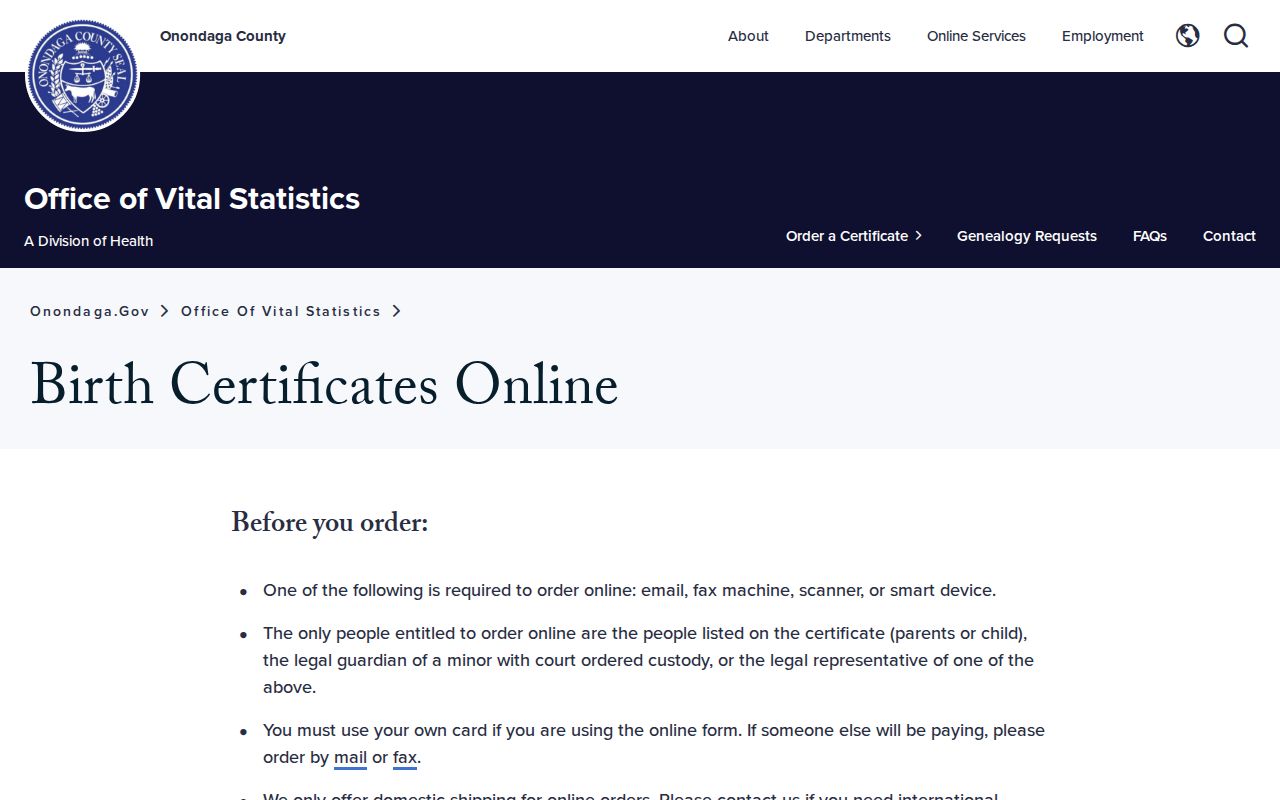
An event record may show relationships or a past address detail, but eligibility and the custodian determine what can be released.
Note: Do not treat a genealogy index, certificate request, or death event as proof that someone currently lives in DeWitt.
Historical Evidence for a DeWitt Resident
When the question is about an earlier household, use dated sources rather than current-property fields. OCPL Local History and Genealogy has staff-assisted directories, census, obituary, cemetery, newspaper, map, and vital-index sources. The DeWitt fiche holdings list 1953, 1955, 1957, 1959, 1961, 1963, 1967, 1969, 1972, 1974, and 1985 under call number LN48 D517 D. Ask staff for a surname, address, and year, and preserve the printed place label because DeWitt, East Syracuse, Jamesville, and Syracuse can appear differently across older material.
For ownership, use Cott’s free guest index to locate grantor or grantee references. Images require an account, and not every index item has an image. If the image is unavailable or paid access is not appropriate, request a copy through the County Clerk or its Archives. Older Cott names may need two searches: before August 21, 2017, an MC surname can be indexed with a space, such as MC CARTHY. That search detail is a useful reproducible note, not proof of identity by itself.
Verify a DeWitt Resident Record
A careful resident lookup records uncertainty at every stage. Begin with the source that actually owns the fact, then add only a second independent source. The workflow below keeps owner, household, court, and historical labels separate.
- Write the full name, known spelling variants, approximate year, and known DeWitt address or parcel. Do not begin from a shared surname alone.
- Check the parcel through RPTS or the DeWitt Assessor when ownership is relevant. Retain the physical property address and the owner mailing field separately.
- Use Cott to test a deed transfer date or an OCPL collection to test a dated household association. Note the result date, document reference, collection year, and spelling used.
- For a court, vital, custody, or voter question, use that system’s limited official route and retain its status label. Contact the custodian for a certified or plain copy only when the record rules permit it.
- Confirm that two independent anchors agree before describing the records as relating to the same person. If they do not agree, stop at the discrepancy and ask the custodian about correction or context.
- Docket
- A court’s case record or case number, which can list parties, dates, and status without proving an allegation or filing is a conviction.
- Index versus image
- An index points to a record and its reference. An image is a view of the underlying document, and Cott makes many images a paid-access item.
- Certified copy
- A copy authenticated by the custodian for a permitted purpose. It is different from a plain copy, a portal result, or a research note.
DeWitt Records Request Fallbacks
When no online result exists, request the existing record from the custodian rather than asking an office to create a directory. New York’s Freedom of Information Law, Public Officers Law Article 6, supports a focused request for existing agency records. Name the agency, describe the record with reasonable specificity, include a date range and preferred delivery format, and provide contact information. Agencies generally grant, deny, or acknowledge a request within five business days, with the response timeline set by the law.
For an address-linked municipal request, DeWitt Code §94-13 identifies permanent code records that include applications, plans, permits, certificates, inspections, complaints, investigations, and fees. The Town Clerk is the Town’s FOIL Officer and records custodian. A narrow request that gives the address and tax-map parcel has a clearer target than a request for names. For County Clerk materials, use the real-property, court, archives, or Surrogate’s route that holds the particular record.
| Source | Fields or request details available | Documented gap |
|---|---|---|
| Cott land records | Grantor, grantee, recording date, instrument or document reference, legal description when shown, and image availability | Live guest-result labels and online coverage cutoff were not captured |
| DeWitt Town Court | Inquiry must give name, birthdate, return address, and phone | No public name docket or live docket field list was located |
| NY voter lookup | Last name, first name, date of birth, county, address information, and ZIP | Public live-result fields were not exposed, and it is not a browseable roll |
| Vital genealogy form | Name variants, parents, spouses, places, years searched, and applicant relationship | It is a search request, not a public certificate display |
DeWitt Resident Lookup Limits
New York protects some records and addresses by design. The Address Confidentiality Program provides qualifying participants a substitute address, and actual addresses are confidential except in limited circumstances. Confidential voter registration under Election Law §5-508 is kept in a separate record. An absent voter result may reflect confidentiality, a mismatch, status, timing, or a portal issue. It does not reveal which explanation applies.
Voter-derived information also has a special use restriction under Election Law §3-103(5). State Board of Elections file requests require an election-purpose statement. FOIL can provide access to existing nonexempt records, but it does not require an agency to create a resident list or disclose protected material. For an error, contact the Assessor, Clerk, Board of Elections, Vital Statistics office, or other custodian that maintains the record.
Lawful use. Use a DeWitt resident lookup for bounded personal, civic, historical, or family research. New York law does not permit stalking, harassment, threats, impersonation, or exposure of protected address information.